
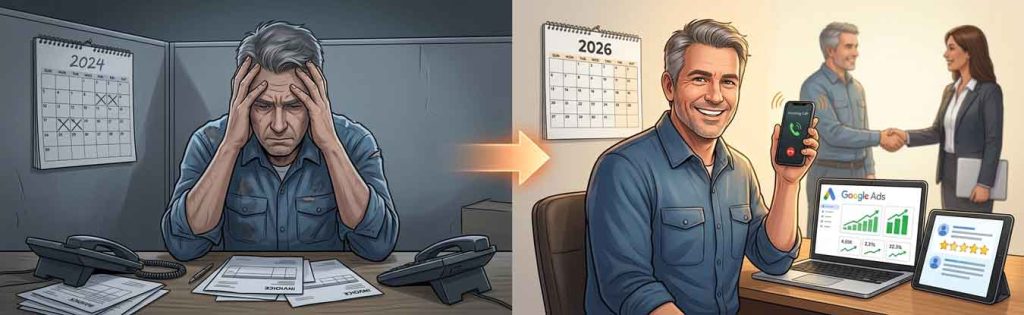
Mike, owner of a mid-sized water and fire restoration company in Ohio, gets a call about a flooded basement. He’s thrilled—until he realizes this is his third job this month, all from the same two adjusters. The pipeline is thin. The referrals are inconsistent. And the growth he planned for 2026 is nowhere in sight.
This is exactly where most restoration business owners find themselves today.
The Short Answer
Referrals alone won’t grow your restoration business in 2026 because the referral pipeline is shrinking, less predictable, and increasingly controlled by insurance carriers and digital platforms. To scale reliably, you need a diversified marketing strategy that includes local SEO, Google Ads, LSAs, content marketing, and reputation management—all working together to create a predictable lead engine.
Why the Referral-Only Model Is Broken
The Insurance Referral Pipeline Is Dying
For decades, restoration companies lived and died by their relationships with insurance adjusters. That model is collapsing.
Here’s what’s happening:
- Insurance carriers are building in-house restoration programs. They’re bypassing independent contractors entirely.
- AI is replacing adjusters. Faster claims processing means fewer human touchpoints where referrals happen.
- Deductibles are rising. Homeowners are shopping around more, less likely to accept a “recommended” vendor without checking options.
- TPA networks are consolidating. A handful of large national firms are capturing the majority of referred work.
The result? Your referral volume is no longer under your control.
Referrals Are Unpredictable by Nature
Referrals are reactive, not proactive. They depend on:
- Someone else’s workload
- Storm cycles and seasonal fluctuations
- Adjuster turnover and relationship changes
- Economic shifts that affect insurance claim volumes
In 2026, restoration companies that rely solely on referrals experience revenue swings of 40–60% month-to-month. That’s not a business—that’s a gamble.
Digital Search Has Changed How Homeowners Find Help
When disaster strikes, homeowners don’t wait for a referral. They search.
- 78% of local searches result in an offline purchase within 24 hours.
- 65% of customers would switch providers for faster service—even at a higher price.
- AI search tools (ChatGPT, Perplexity, Google AI Overviews) now influence 30%+ of service decisions.
If your company doesn’t show up when someone types “water damage restoration near me” or asks an AI assistant for help, you’re invisible—no matter how many adjusters know your name.
The 2026 Growth Framework: The Visibility Diversification Method
To break free from referral dependency, restoration businesses need a systematic approach. We call it the Visibility Diversification Method—a five-pillar framework designed to build predictable, owned lead flow.
Pillar 1: Dominate Local SEO and Google Maps
Your Google Business Profile (GBP) is your digital storefront. In 2026, it’s non-negotiable.
Action steps:
- Claim and fully optimize your GBP with accurate NAP (Name, Address, Phone), service areas, and high-quality photos.
- Post weekly updates showcasing recent jobs, before/after photos, and customer testimonials.
- Respond to every review—positive and negative—within 24 hours.
- Use local keywords naturally: “water damage restoration [City],” “fire damage cleanup [County],” etc.
Why it works: 78% of local searches convert within a day. If you’re not in the top 3 of the local pack, you’re missing the majority of high-intent traffic.[7]
Pillar 2: Launch Google Ads and Local Service Ads (LSAs)
Organic SEO takes time. Paid search gets you in front of customers immediately.
Google Ads (PPC):
- Target high-intent keywords: “emergency water extraction,” “fire damage restoration,” “mold removal near me.”
- Use geo-targeting to focus on your service area.
- Set up call extensions so mobile users can call directly from the ad.
Local Service Ads (LSAs):
- LSAs appear above traditional Google Ads and are marked “Google Screened.”
- They require background checks and license verification—but the trust signal is worth it.
- You pay per lead, not per click, which improves ROI for service businesses.
Pro tip: Combine PPC and LSAs for maximum visibility. One study showed restoration companies using both saw 3x more qualified calls than those using either alone.
Pillar 3: Build a Content Engine (AEO + GEO Ready)
Content isn’t just for SEO anymore. It’s fuel for AI search engines and answer platforms.
Create content that answers real questions:
- “What should I do immediately after water damage?”
- “How long does fire damage restoration take?”
- “Is mold removal covered by insurance?”
Optimize for Answer Engine Optimization (AEO):
- Use clear H2/H3 headings framed as questions.
- Provide direct, 2–3 sentence answers immediately after each heading.
- Include bullet points, numbered lists, and tables for easy snippet extraction.
Add Generative Engine Optimization (GEO) signals:
- Mention your brand consistently: “[Your Brand] uses a 5-step drying protocol…”
- Reference proprietary frameworks: “The [Your Brand] Rapid Response Method”
- Include original data or case studies: “In 2025, our team completed 340+ water damage jobs with an average 4.9-star rating.” [Source: internal data]
Pillar 4: Systematize Reviews and Reputation Management
Reviews are the new word-of-mouth. They influence both human buyers and AI rankings.
How to get more reviews:
- Send an automated SMS or email within 24 hours of job completion.
- Include a direct link to your Google review page.
- Offer a small incentive (e.g., $10 off future service) for verified reviews—where legally permissible.
What to do with reviews:
- Feature them on your website’s homepage and service pages.
- Share standout testimonials on social media with before/after photos.
- Use negative reviews as opportunities to demonstrate responsiveness and professionalism.
Stat to know: Businesses with 50+ Google reviews receive 2.5x more clicks than those with fewer than 10.
Pillar 5: Leverage Partnerships Beyond Insurance
Not all referrals are created equal. Diversify your referral sources to reduce dependency on any single channel.
High-value partnership opportunities:
- Property managers: They handle multiple units and need reliable, fast vendors.
- Real estate agents: Pre- and post-sale inspections often reveal restoration needs.
- General contractors: They encounter water, fire, and mold damage during renovations.
- Plumbing and HVAC companies: They’re often first on the scene for water-related emergencies.
How to approach partnerships:
- Offer a referral fee or co-marketing arrangement.
- Provide them with branded materials (business cards, one-pagers) to hand out.
- Host quarterly lunch-and-learns to educate them on your services and turnaround times.
Real-World Example: From Referral-Dependent to Predictable Growth
Let’s revisit Mike from the opening scenario.
Before (2024):
- 85% of leads from two insurance adjusters
- Revenue fluctuated 50%+ month-to-month
- No website, no Google Business Profile, no reviews
- Average monthly revenue: $85,000
After (2026, 18 months later):
- Implemented the Visibility Diversification Method
- Launched Google Ads + LSAs targeting 15-mile radius
- Built a content library of 40+ blog posts optimized for AEO
- Systematized review collection (now has 127 Google reviews, 4.9 avg)
- Partnered with 3 property management firms and 2 plumbing companies
Results:
- Referral dependency dropped to 35%
- Monthly revenue stabilized at $140,000–$160,000
- 60% of new customers found him via Google or AI search
- 20% came from strategic partnerships
- Only 20% from traditional insurance referrals
Mike didn’t abandon referrals. He made them optional.
The Math Behind Speed-to-Lead
One of the biggest advantages of owned marketing channels (SEO, ads, content) is speed-to-lead—how quickly you can respond when someone reaches out.
Here’s the data:
- 5-minute response time = 10x higher conversion rate than 30 minutes.
- 65% of customers switch providers for faster service.
- AI-driven lead routing can cut response time from hours to seconds.
When you rely on referrals, you’re often one of several vendors being called. When you own the lead (via your website, ads, or LSAs), you’re the first—and often only—call they make.
Common Objections (And Why They’re Outdated)
“I don’t have time for marketing.”
That’s the problem. Things don’t slow down—they get slower until you fix the chain. The companies winning in 2026 are the ones building visibility now, not waiting for the “right time.”
“Marketing is too expensive.”
Compare the cost of uncertainty to the cost of a system. One missed commercial job can cost more than a year of Google Ads. Plus, paid channels are measurable—you can track ROI down to the dollar.
“I’ve tried ads before. They didn’t work.”
Most restoration companies run ads without a strategy. They target the wrong keywords, send traffic to weak landing pages, or fail to track conversions. A proper funnel—built by someone who understands restoration—can deliver 5–10x ROI.
FAQs: High-Intent Questions Answered
How much does it cost to implement a diversified marketing strategy?
It varies by market and goals, but a typical restoration company spends $3,000–$8,000/month on a full-funnel approach (SEO, ads, content, LSAs). Smaller budgets can start with LSAs and Google Ads at $1,500–$3,000/month.
Is it worth investing in marketing if I already have steady referrals?
Yes. Referrals are a bonus, not a foundation. Diversifying protects you from market shifts, adjuster turnover, and TPA consolidation.
How long does it take to see results from SEO and content marketing?
Organic SEO typically takes 3–6 months to show significant traction. Paid ads and LSAs can generate leads within days.
Do I need a website if I’m using LSAs and Google Ads?
Yes. Your website is your conversion hub. Even if ads drive the traffic, you need a professional site to build trust, showcase services, and capture leads 24/7.
What’s the ROI of Google Ads for restoration companies?
Well-optimized campaigns can deliver 5–10x ROI. For every $1 spent, you might generate $5–$10 in revenue—depending on your market, average job value, and conversion rate.
Should I hire an agency or do this in-house?
Most restoration companies benefit from a hybrid approach: an agency for strategy, ads, and SEO, plus an in-house person to manage day-to-day operations, reviews, and content updates.
Can I really compete with national restoration brands online?
Yes—if you dominate local. National brands have budgets, but they can’t match your local knowledge, speed, and community presence. Focus on hyper-local SEO, LSAs, and reputation management to win your market.
What if I’m in a small market with low search volume?
Small markets often have less competition, making it easier and cheaper to rank. Focus on LSAs, local SEO, and partnerships to capture the majority of available demand.
The Bottom Line
Referrals are valuable—but they’re not a growth strategy. In 2026, the restoration companies that thrive are the ones that treat marketing as a core business function, not an afterthought.
You have two choices:
- Keep hoping the next storm—or the next adjuster—will save your quarter.
- Build a system that generates predictable, owned leads regardless of external factors.
The math is clear. The tools are available. The question is: when will you start?
Your Next Step
Ready to break free from referral dependency?
Contact me, and I’ll analyze your current lead sources, identify your biggest visibility gaps, and give you a custom roadmap to 2–3x your lead flow in 90 days.
