
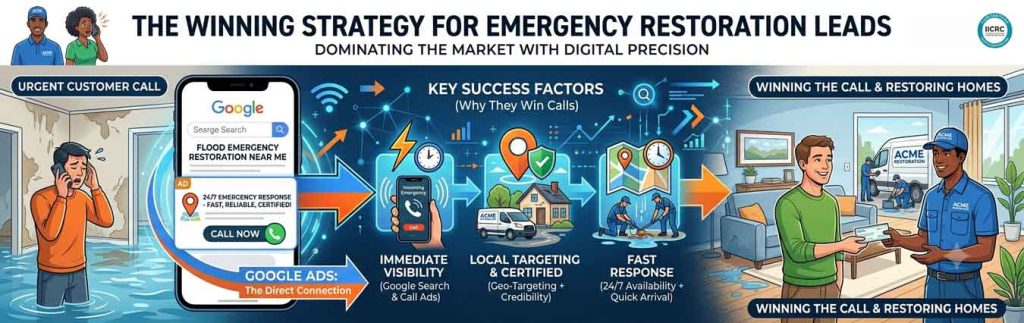
Imagine this: it’s 2 a.m., and a burst pipe has just flooded Maria’s kitchen. Water is creeping toward the hallway, and she’s standing in her robe with her phone in her hand, typing “water damage restoration near me” into Google. She doesn’t care about brand loyalty. She doesn’t want to scroll through five websites. She wants the first company that answers the phone and shows up fast.
This is exactly where most restoration companies win or lose the call in the first ten seconds of a Google search.
The Direct Answer: How Restoration Companies Win More Emergency Calls
Restoration companies win more emergency calls with Google Ads by combining tightly targeted “near me” and disaster-specific keywords, call-only ad formats, 24/7 phone tracking, and location-based bid adjustments that push spend toward the hours and ZIP codes where floods, fires, and mold jobs actually happen. The goal isn’t traffic. It’s the phone ringing within minutes of a disaster.
Water damage, fire damage, and mold remediation are almost entirely need-based services. Nobody browses for a restoration company on a lazy Sunday afternoon. They search when the basement is flooding or the smoke alarm just went off. That single fact should shape every part of a restoration company’s Google Ads strategy.
Why This Search Has Almost No “Just Looking” Traffic
Most industries have a mix of browsers and buyers. Restoration is different. Someone searching “emergency water extraction Denver” at 3 a.m. isn’t comparison shopping for fun, they’re in crisis mode, and they’ll book with whoever feels fastest and most credible.
That changes how a restoration company should think about intent:
- Primary intent: Transactional. The searcher wants to book emergency service, often within the hour.
- Secondary intent: A smaller slice is Commercial homeowners comparing two or three companies before calling, usually for non-urgent jobs like mold inspection or post-fire cleanup planning.
- Rare intent: Informational searches (“how does water damage restoration work”) mostly come from insurance adjusters, property managers, or people researching for future reference.
In reality, most restoration ad budgets should lean heavily toward capturing that transactional, right-now searcher because that’s where the revenue actually lives.
A Framework: The 4-Layer Emergency Ads System
Here’s a simple framework, call it the Rapid Response Ads Method, that restoration companies can use to structure a Google Ads account that actually converts panic into paying jobs.
Step 1: Build Disaster-Specific Ad Groups, Not One Generic Campaign
Water damage, fire damage, mold remediation, and storm damage are different emergencies with different urgency levels and different searchers. Lumping them into one “restoration services” campaign wastes budget on irrelevant clicks.
Instead, separate campaigns by:
- Water damage / flood restoration
- Fire and smoke damage
- Mold remediation
- Storm and disaster cleanup
Each campaign should have its own ad copy, landing page, and keyword list. A homeowner searching “fire damage cleanup” doesn’t want to land on a generic “restoration services” page, they want to see fire-specific language immediately.
Step 2: Prioritize Call-Only and Call Extension Ads
For emergency services, a phone call converts faster than a form fill. Call-only ad formats where the ad exists purely to trigger a phone call consistently outperform standard search ads for this industry, because the searcher’s whole intent is “get someone on the phone now.”
Pair this with:
- Call extensions on every standard search ad
- Location extensions showing proximity (“serving [City] average 45-minute response time”)
- Sitelink extensions pointing to insurance-claim help, since many customers are worried about cost
Step 3: Use Dayparting and Geo-Bid Adjustments
Disasters don’t follow business hours. However, that doesn’t mean every hour deserves equal ad spend. Historical data usually shows spikes around storms, holiday weekends (frozen or burst pipes), and overnight hours when panic searches happen but competitors pause their ads to save budget.
A smart restoration company:
- Increases bids during storm forecasts and freezing temperature alerts
- Maintains 24/7 visibility, since emergencies don’t wait for 9 a.m.
- Adjusts bids upward in ZIP codes with older housing stock or recent storm activity, where damage claims are more likely
Step 4: Track Calls, Not Just Clicks
Here’s the truth most agencies won’t tell you: click-through rate means very little in this industry. What matters is call volume, call duration, and how many of those calls turn into booked jobs. Without call tracking, a restoration company is essentially flying blind, spending money without knowing which keywords, ads, or times of day actually produce paying customers.
Call tracking numbers, paired with recordings or transcripts, let a company see exactly which ad groups produce real emergency bookings versus tire-kicker calls from insurance shoppers.
A Realistic Example
Consider a mid-sized restoration company operating across three counties. Before restructuring their Google Ads account using this framework, they ran one broad campaign targeting “restoration services” with a shared budget and generic landing page. Cost per lead hovered around $85, and a large share of calls came from people simply asking about pricing months in advance.
After splitting campaigns by disaster type, switching to call-only ads for water and fire emergencies, and adding geo-bid adjustments during a regional storm system, cost per booked job dropped noticeably, and same-day call volume increased. The biggest shift wasn’t more traffic; it was more of the right traffic, calling at the moment they needed help most.
This mirrors a broader industry pattern: home service companies that separate urgent and non-urgent campaigns typically see stronger return on ad spend than those running one blended account, simply because urgent searchers respond to different messaging and timing than researchers do.
Quick-Reference: Emergency vs. Non-Emergency Campaign Setup
| Element | Emergency Campaigns (Water/Fire) | Non-Emergency Campaigns (Mold Inspection, Estimates) |
| Ad format | Call-only, mobile-first | Standard search with form fill |
| Bidding | 24/7, boosted during storms | Standard business hours |
| Keywords | “emergency,” “24 hour,” “now,” “near me” | “how much does,” “signs of,” “inspection” |
| Landing page | Fast-loading, phone number above the fold | Educational content, service comparison |
| Success metric | Call volume, booked jobs | Form fills, estimate requests |
Frequently Asked Questions
How much does Google Ads cost for a restoration company?
Costs vary by market, but restoration keywords are competitive due to high insurance-related job values. Many companies budget between $3,000 and $10,000 per month, with cost per click often ranging from $15 to $50 for water and fire damage terms.
Is Google Ads worth it for restoration companies compared to SEO?
Yes, especially for emergency services, because Google Ads produces calls within hours while SEO can take months to rank. Most successful companies run both, using Ads for immediate emergency calls and SEO for longer-term brand visibility.
How long does it take to start getting calls from Google Ads?
Ads can start driving calls the same day they go live, though it typically takes one to two weeks of data to optimize keywords, bids, and ad copy for consistent results.
Do restoration companies need a separate campaign for each city they serve?
For companies serving multiple distinct service areas, geo-targeted campaigns or ad groups usually perform better than one broad regional campaign, since they allow more precise bid control and localized messaging.
What’s the biggest mistake restoration companies make with Google Ads?
Running one blended campaign for both emergency and non-emergency services. This mixes buyer intent, muddies performance data, and often wastes budget on low-urgency clicks.
Can Google Ads help with insurance-related jobs specifically?
Yes. Ad copy and landing pages that mention insurance claim assistance tend to build trust quickly, since cost is often a searcher’s biggest hidden objection during a crisis.
Should restoration companies pause ads at night to save budget?
No. Since emergencies happen around the clock, pausing overnight often means missing the exact moment a competitor’s ad is the only one visible.
Turning Panic Searches Into Booked Jobs
Maria’s flooded kitchen didn’t wait for business hours, and neither did her Google search. The restoration companies winning these moments aren’t necessarily spending the most; they’re structured to show up fast, sound credible in the ad itself, and make calling feel like the obvious next step.
If your current Google Ads account is one big campaign trying to cover everything from mold inspections to 2 a.m. flood emergencies, it’s likely costing you real jobs. A focused account structure, built around actual search intent and response speed, tends to outperform a generic one every time.
Ready to see where your current ads are leaking emergency calls?
A free Google Ads Audit can show exactly which keywords and hours are underperforming. For companies wanting a deeper look at building call-driven campaigns, check out the related blog post.
