
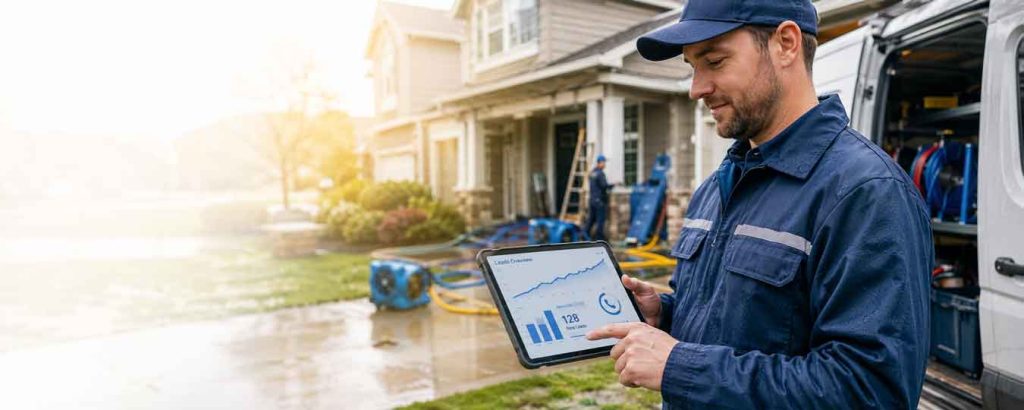
Imagine this: a burst pipe just flooded a family’s basement at 11 p.m. on a Tuesday. The homeowner grabs their phone and searches “water damage restoration near me.” Three ads show up. They call the first one that picks up. That’s exactly where most restoration company owners find themselves watching leads go to a competitor simply because that competitor showed up first on Google.
If you run a restoration business, you already know the stakes. Emergencies don’t wait for business hours, and neither do your customers’ searches.
How Google Ads Works for Restoration Companies
Google Ads works for restoration companies by placing your business at the top of search results the moment someone searches for urgent help — water damage, fire damage, mold removal, or storm cleanup. Because these are high-intent, often emergency searches, restoration companies typically see faster conversion rates than most other local service industries. A well-structured campaign with tight geographic targeting, call-only ads, and 24/7 bid scheduling can generate qualified leads within days, not months.
Why Restoration Companies Need a Different Google Ads Approach
Restoration is not like typical home services. Nobody plans ahead for a house fire. This changes everything about how you should structure campaigns.
In reality, most restoration searches happen in one of two states: panic or urgency. Someone just discovered mold behind their drywall, or their basement is currently underwater. They’re not comparing five quotes, they’re calling whoever answers first with confidence.
This means your Google Ads strategy needs to prioritize:
- Speed of response over polished branding
- Phone calls over form fills
- Local presence over broad reach
- Trust signals over clever copywriting
We call this approach the Rapid Response Method — a framework built specifically around how restoration customers actually behave, not how a generic home services playbook assumes they behave.
The Rapid Response Method: A Step-by-Step Framework
Here’s how to structure a Google Ads campaign for a restoration company that converts.
Step 1: Build Separate Campaigns by Service Type
Don’t lump water damage, fire damage, mold remediation, and storm restoration into one campaign. Each has different search volume, urgency levels, and customer psychology.
Splitting campaigns lets you control budget and messaging independently. Water damage typically drives the highest volume, while fire damage often has higher value per job.
Step 2: Use Call-Only and Call Extension Ads
Most restoration customers want to talk to a human immediately, not fill out a form and wait. Call-only ad formats remove the extra click and get the phone ringing faster.
Step 3: Set Geo-Targeting to Your Actual Service Radius
Restoration is hyper-local. A company in Dallas doesn’t want clicks from Fort Worth if they can’t dispatch a crew there within the hour. Narrow targeting by ZIP code or drive-time radius, not just city name.
Step 4: Schedule Bids for 24/7 Coverage — With Adjustments
Emergencies happen at 2 a.m. If you have after-hours dispatch, don’t turn off your ads at 5 p.m. Instead, adjust bids so you’re competitive around the clock but slightly more aggressive during peak disaster hours (early morning after storms, for example).
Step 5: Write Ad Copy Around Urgency and Reassurance
Your headline needs to answer two questions in under five seconds: “Can you help me right now?” and “Can I trust you?” Phrases like “24/7 Emergency Response” and “IICRC Certified Technicians” do both jobs at once.
Step 6: Send Traffic to Service-Specific Landing Pages
A generic homepage loses conversions. A dedicated water damage restoration landing page, with a phone number above the fold and real reviews, converts significantly better.
Step 7: Track Calls, Not Just Clicks
Click data alone won’t tell you which campaigns actually generate paying jobs. Call tracking software connected to your Google Ads account is non-negotiable for this industry.
Real-World Example: What Results Actually Look Like
A mid-sized restoration company in the Midwest — we’ll call them a typical three-truck operation — restructured their campaigns using this exact framework. Before, they ran one broad campaign covering all services and all of their metro area.
After splitting into service-specific campaigns with call-only ads and a 15-mile radius target, their cost per lead dropped from around $95 to roughly $58 within eight weeks. More importantly, their close rate on ad-generated leads rose because the leads coming in matched their actual service area and capacity.
This pattern shows up consistently: tighter targeting plus faster response paths beat broad reach almost every time in restoration marketing.
What Restoration Ads Typically Cost in 2026
| Metric | Typical Range |
| Cost per click (water damage) | $15–$60 |
| Cost per click (fire damage) | $25–$70 |
| Cost per click (mold remediation) | $12–$35 |
| Average cost per lead | $80–$200 |
These numbers vary by market size and competition, but they give you a realistic budget baseline before you launch.
Frequently Asked Questions
How much does Google Ads cost for a restoration company?
Most restoration companies spend between $2,000 and $8,000 per month on Google Ads, depending on market size and competition. Smaller markets with less competition can see solid results starting at around $1,500 per month.
Is Google Ads worth it for restoration businesses?
Yes, because restoration searches are almost always high-intent and time-sensitive, which typically leads to faster conversions than industries where customers browse casually. A single fire or flood restoration job can be worth thousands of dollars, making even a moderate ad spend easy to justify.
How long does it take to see results?
Most restoration companies start seeing calls within the first week, since Google Ads (unlike SEO) doesn’t require months of ranking buildup. However, optimizing cost per lead to an efficient level usually takes 4–8 weeks of data and adjustments.
What’s the difference between Google Ads and SEO for restoration companies?
Google Ads delivers immediate visibility for a price per click, while SEO builds long-term organic visibility that takes months to develop but costs nothing per click once ranked. Most successful restoration companies run both simultaneously.
Should I use Local Service Ads (LSAs) instead of regular Google Ads?
Local Service Ads work well as a complement to standard Google Ads, especially since they include the Google Guarantee badge that builds instant trust. Many restoration companies run both, since LSAs often drive lower-cost leads while standard Ads campaigns let you scale volume faster.
How do I know if my restoration ads are actually working?
Track phone calls that convert into booked jobs, not just clicks or form submissions, since click volume alone doesn’t reflect revenue. A call tracking system tied directly to your Google Ads account is the most reliable way to measure true ROI.
Can small restoration companies compete with national chains on Google Ads?
Yes, because Google Ads rewards relevance and response speed as much as budget size. A local company with faster call response and hyper-targeted geography can outperform a national brand’s broader, less personalized campaigns.
Conclusion: Turning Searches Into Service Calls
Remember that homeowner with the flooded basement? In a market where restoration companies use the Rapid Response Method, that call goes to a business that’s targeted, ready, and easy to reach, not whoever happened to spend the most on a broad campaign.
Google Ads isn’t optional for restoration companies in 2026. It’s the fastest way to reach people in exactly the moment they need help most. The businesses that win aren’t necessarily the biggest; they’re the ones structured to respond fastest and show up in the right ZIP codes at the right hour.
Ready to see what a properly structured campaign could do for your call volume?
Akhlak offers a free Google Ads audit for restoration companies — no obligation, just a clear breakdown of where your current campaigns are leaking budget and where the opportunity is.
We’ve helped restoration companies across the country lower their cost per lead while increasing job volume, backed by a track record you can verify through client references upon request.
