
A restoration company owner once told us he was losing money on Google Ads and couldn’t figure out why. His click volume looked healthy. His budget was gone by noon most days. But his phone wasn’t ringing with the right calls, he was getting fire quote requests routed to a landing page built for mold inspections. The campaign structure was the problem, not the ad spend.
That mix-up is more common than most restoration companies realize. Water, fire, and mold are three different services with three different customer mindsets, three different urgency levels, and three different price points. Lump them into one campaign, and Google’s algorithm and your customers get confused.
This guide breaks down exactly how to structure a Google Ads account for a restoration business so each service gets its own lane, its own budget, and its own path to a booked job.
The Right Way to Structure This Campaign
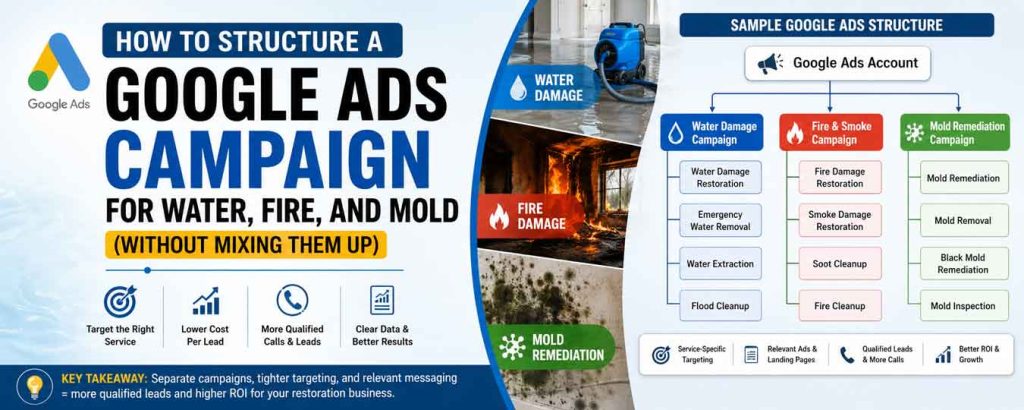
The short version: build three separate campaigns, one each for water damage, fire damage, and mold remediation instead of one combined “restoration services” campaign.
Each campaign needs
- its own ad groups split by specific search intent (emergency vs. inspection vs. informational),
- its own landing pages, and
- its own budget controls.
This keeps Google’s Quality Score high, keeps your cost-per-click lower, and routes each caller to the right service page instead of a generic homepage.
Why Mixing Services Into One Campaign Hurts Performance
Here’s the truth: Google Ads rewards relevance. When one ad group contains keywords for “water damage restoration,” “smoke damage cleanup,” and “mold testing,” none of your ads can be tightly relevant to all three. Quality Score drops. Cost per click climbs.
There’s also a human reason this matters. Someone searching “emergency water extraction near me” at 2 a.m. is in crisis mode. Someone searching “mold inspection cost” is comparison shopping and can wait a few days. Serving both the same ad copy and the same generic landing page ignores that gap in urgency and it shows in your conversion rate.
We’ve seen restoration companies cut cost-per-lead by 30–40% simply by splitting a combined campaign into service-specific ones. That’s not a guess; it’s a pattern that shows up almost every time a blended account gets restructured.
Section summary: One blended campaign forces generic messaging. Three focused campaigns let each ad, keyword, and landing page match exactly what the searcher wants.
The Three Service Entities You’re Actually Advertising
Before building anything, it helps to think of water, fire, and mold as three separate businesses sharing one brand name.
- Water damage restoration — burst pipes, flooding, sewage backup, water extraction, structural drying
- Fire damage restoration — smoke damage, soot removal, odor treatment, board-up services, contents cleaning
- Mold remediation — mold inspection, mold testing, mold removal, air quality assessment
Related entities worth weaving into your ad copy and landing pages include insurance claims assistance, 24/7 emergency response, licensed and certified technicians, and local service-area terms (your city, county, or metro name). These aren’t just keywords; they’re the vocabulary your actual customers use when they’re stressed and searching for help.
Step-by-Step Framework: Building the Campaign Structure
1. Create three standalone campaigns
Set up separate campaigns named clearly:
- “Water Damage — [City],”
- “Fire Damage — [City],”
- “Mold Remediation — [City].”
This isn’t just organizational tidiness; it lets you set different budgets, different bid strategies, and different ad schedules for each.
Water damage, for instance, often needs 24/7 bidding because pipes burst at night. Mold remediation searches skew more toward business hours, when homeowners are researching calmly.
2. Split ad groups by intent, not just keyword
Inside each campaign, build ad groups around distinct intent clusters:
- Emergency/transactional — “emergency water damage repair,” “24 hour flood cleanup”
- Commercial/comparison — “best water damage company near me,” “water restoration cost”
- Informational — “how to dry out a flooded basement,” “signs of mold after water damage”
Each ad group should have 10–20 tightly related keywords, not a grab-bag of 100.
3. Write ad copy matched to urgency
Emergency ad groups need direct, action-first copy: “Water in Your Home Right Now? We Arrive in 60 Minutes.” Informational ad groups can afford a softer approach that builds trust before the ask.
4. Build dedicated landing pages
Each service and ideally each intent level should land on a page built for that exact search. A fire damage emergency page needs a phone number above the fold and minimal scrolling. A mold inspection informational page can include more educational content and a soft-conversion form.
5. Set negative keywords across campaigns
This is the step that actually prevents the “mixing up” problem. Add “mold” as a negative keyword to your water and fire campaigns, and vice versa, so Google never crosses your ads between service lines by accident.
6. Track conversions by campaign, not just account-wide
Set up separate conversion tracking (or at minimum, separate labels) for each campaign so you can see which service is actually profitable, not just which one gets the most clicks.
Section summary: Three campaigns, intent-based ad groups, matched landing pages, cross-campaign negative keywords, and separate conversion tracking form the backbone of a clean restoration account.
Real-World Example: What Restructuring Looks Like
Consider a mid-sized restoration company running one combined campaign with a $6,000 monthly budget. Their cost-per-lead sat around $145, and roughly a third of leads were mismatched fire callers landing on a water-focused page, for example.
After splitting into three campaigns with dedicated landing pages and negative keyword lists, cost-per-lead dropped to around $95 within the first two months. Water damage, their highest-margin emergency service, got its own budget priority and started pulling in same-day jobs instead of getting outbid by lower-intent mold searches eating into shared budget.
The lesson here isn’t that ad spend needs to go up. It’s that structure decides where the spend actually lands.
What Belongs on Each Landing Page
| Service | Above-the-Fold Priority | Key Trust Signal | Conversion Type |
| Water Damage | Phone number, “arrive in X minutes” | 24/7 availability | Call now |
| Fire Damage | Emergency contact, insurance claim help | Certified fire restoration crew | Call or form |
| Mold Remediation | Free inspection offer | Licensed mold assessor | Form or scheduled call |
Frequently Asked Questions
How much does it cost to run separate Google Ads campaigns for restoration services?
There’s no extra platform fee for running three campaigns instead of one. Google Ads doesn’t charge per campaign. Your total budget stays whatever you set; it’s just allocated more precisely across water, fire, and mold instead of blended together.
Is it worth splitting campaigns instead of running one combined restoration campaign?
Yes, in almost every case we’ve seen. Restoration companies that split by service typically see lower cost-per-click and fewer mismatched leads within the first month, because Quality Score improves when ads and keywords stay tightly relevant.
How long does it take to see results after restructuring a campaign?
Most accounts show a measurable Quality Score and cost-per-click improvement within 2–4 weeks, since Google needs a data collection period to re-evaluate relevance. Full budget optimization across all three campaigns usually takes 60–90 days.
Do I need separate landing pages for each service, or can I use one page with sections?
Separate pages perform better because each one can be built around a single intent; emergency water damage searchers need different content and layout than someone researching mold testing costs. A single multi-section page dilutes relevance signals for Google Ads Quality Score.
Should water, fire, and mold campaigns have the same daily budget?
No, budgets should reflect job value and urgency. Water and fire damage jobs are often higher-ticket and time-sensitive, so many restoration companies weight those campaigns higher than mold remediation, then adjust based on actual lead-to-job conversion data.
What negative keywords are most important for restoration campaigns?
Cross-service terms are the priority. Add “mold” as a negative to water and fire campaigns, and add “flood” or “fire” as negatives to your mold campaign. This is the single biggest fix for the “mixing up” problem this article addresses.
Can I still run one combined campaign if my budget is small?
It’s possible, but a small budget is actually a stronger reason to separate campaigns, not a reason to combine them. A blended campaign with limited spend gets diluted across three intents and rarely performs well for any of them. Starting with just one focused service campaign (often water damage, since it converts fastest) tends to outperform a thin combined budget.
Conclusion: Structure First, Then Scale
Water, fire, and mold restoration each have their own customer, their own urgency, and their own path to conversion. Treating them as one campaign because they share a business name is where most restoration Google Ads accounts lose money.
Split the campaigns. Match the ad groups to intent. Build landing pages that speak to exactly what the searcher needs in that moment. Do that, and the budget you already have will work harder without spending an extra dollar.
Ready to see where your current campaign is losing leads?
At Akhlak, we offer a free Google Ads audit for restoration companies. We’ll show you exactly where water, fire, and mold traffic is getting crossed, and what it’s costing you.
